SALT LAKE CITY – This year’s midterms in Utah had the chance to send a Democrat to the U.S. House of Representatives, flip control of the Salt Lake County Council, and enact an amendment to the state constitution that would restrict tax-increasing citizen-led ballot initiatives.
Along the campaign trail, Utahns asked for candidates that would defend them on critical issues. Candidates faced questions about data centers, Flock Safety cameras, public lands, and Immigration and Customs Enforcement enforcement.
Polls closed in Utah at 8 p.m. on Nov. 3. Due to longer lines at the polls, election officials began updating the state’s election website later than usual, at 9 p.m. The website is populated with early, unofficial results as county clerks report vote counts.
Although the results won’t be certified until the statewide canvass on Nov. 23, races may be called much sooner.
Who won Utah’s 1st Congressional District?
Democrat Ben McAdams has defeated Republican Riley Owen in the race for Utah’s 1st Congressional District, according to the Associated Press, which called the race for McAdams at 10:26 p.m. on Nov. 3. McAdams currently holds a 72% to 25% lead over Owen, with 59% of the vote counted.
The district, which covers most of Salt Lake County, was created by a new congressional map a judge adopted on Nov. 10, 2025, after a years-long court fight over Utah’s districts. It is the first Utah district in decades drawn to favor Democrats.
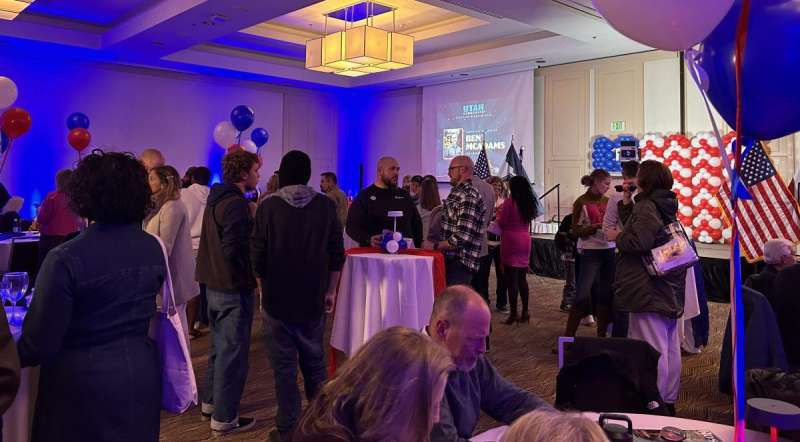
“Tonight, in the district that you fought to create, the people of Salt Lake County picked their own representative,” McAdams told a packed room at the Utah Democratic Party’s election night celebration.
McAdams, the last Utah Democrat to serve in Congress, was heavily favored throughout his campaign. Owen is a 27-year-old intelligence officer in the Navy Reserve. Libertarian Jesse West and unaffiliated candidate Elias Montgomery are also on the ballot.
Did Democrats win control of the Salt Lake City Council?
Leading up to the midterms, Republicans controlled the Salt Lake County Council with a 5-4 majority. But with four of the council’s nine seats up for grabs this midterm, Democrats flipped control.
As of Nov. 5 at 9:20 a.m., Democrats had won two council seats and were leading a third race.
To win control of the council, Democrats needed to win at least two of the four seats.
Who won Salt Lake County Council At-Large A?
Democrat Zach Robinson won the Salt Lake County Council District 3 seat after Republican Kathleen Anderson conceded on Nov. 4. Robinson currently leads Anderson 65.09%% to 32.65%, with 928/1006 precincts reporting.
“Thank you, Salt Lake County, for your trust and your votes. I am honored to have the chance to serve you on the County Council!” Robinson wrote on social media.
It’s the only countywide seat on the ballot, and Robinson will serve a six-year term. Anderson ousted Republican incumbent Laurie Stringham at the county GOP convention in April. Constitution Party candidate Gregory Beglarian, Utah Forward Party candidate Maleah Bliss Caulford and unaffiliated candidate Olghen Ocean Saintelus also ran.
Salt Lake County Council District 3
Democrat Luke Maynes has won the race for the Salt Lake County Council District 3 seat, following Republican Mike Bird’s concession on Nov. 4. Maynes currently leads Republican Mike Bird 60.02% to 39.98%, with 143 of 148 precincts reporting.
“I look forward to working with my colleagues on the County Council to reduce costs and expand services for County families. Together, we can build the County we deserve,” Maynes wrote in a celebratory social media post.
Maynes replaces Republican council member Aimee Winder Newton, who didn’t seek reelection, and will serve a four-year term representing Taylorsville, Murray and West Jordan. The race drew attention over a controversial endorsement and questions about Bird’s GOP roots.
Who won Utah’s key state Senate races?
Republicans hold 22 of the Utah Senate’s 29 seats. New senators take office Jan. 1, 2027.
Senate District 5
Democrat CJ Hernandez has won the race for Utah’s Senate District 5, following Republican Jill Koford’s concession. According to Decision DeskHQ, Hernandez currently leads Koford 56% to 44% as of 11:32 p.m. Nov. 4, with about 91% of expected votes counted.
“I look forward to working with my colleagues on both sides of the aisle to improve life for working families. The real work starts now,” Hernandez wrote on social media.
The seat, held by retiring Republican Sen. Ann Millner, includes Ogden, Riverdale and Washington Terrace. Koford is finishing her first term in the House, and Hernandez is a former diplomat.
The area has seen tensions between residents and law enforcement over ICE arrests and Flock camera use. Both candidates back more regulation of Flock cameras, but they split on immigration. Koford has voted for stricter immigration laws, while Hernandez has spoken against mass detention and called for an overhaul of the immigration system.
Senate District 12
Democrat Karen Kwan has won the race for Utah’s Senate District 12, according to the Associated Press. Kwan currently leads Republican Deidre Tyler 62% to 38% with 68% of the vote counted.
“I’m filled with gratitude at the opportunity to serve another term as your state senator… I am excited to continue the work at the Capitol to represent Taylorsville, West Valley and Kearns,” Kwan wrote in a social media post on Nov. 4.
The district covers Taylorsville, West Valley City and Kearns and is one of the most diverse in the state, with a large immigrant population.
Senate District 19
Democrat Shana Anderson has won the race for Utah’s Senate District 19, according to the Associated Press. Anderson leads Republican Kirk Cullimore Jr. 54% to 46% with more than 95% of the vote counted.
“I am humbled and honored to be your next state senator. This win belongs to us all. Now the real work begins, and we’ll do that together too,” Anderson wrote in a social media post.
The district covers Sandy, Draper and Alta. Cullimore has been in the state Senate since 2019, won District 19 in 2022 and became majority leader in 2025. He was the Senate sponsor of the 2025 law banning fluoride in public drinking water, the first state ban of its kind.
In 2020, housing advocates opposed a Cullimore bill they said could let landlords add clauses to leases that waive renters’ right to contest an eviction in court, Salt Lake Tribune columnist Robert Gehrke reported. Cullimore, whose family’s law firm handles evictions, said that wasn’t his intent.
Anderson, a first-time candidate with a background in economics, campaigned on changing tax law to benefit owner-occupied homes.
Did Amendment B pass in Utah?
Amendment B has failed in Utah, according to the Associated Press, which projected its passage at 9:36 p.m. on Nov. 3. The measure currently has 62.2% support from Utah voters, with only 37.8% voting against it, with 51% of votes counted.
The constitutional amendment, put on the ballot by the Legislature, would have required 60% voter approval for citizen initiatives that create, expand or raise taxes. It will continue to pass with a simple majority, meaning more yes votes than no.
Supporters, including the Utah Taxpayers Association, said tax increases should require broader support. Opponents, including Better Boundaries and Planned Parenthood, said it weakens citizens’ power to make laws. Opponents pointed out that the Medicaid expansion and medical marijuana initiatives wouldn’t have passed under a 60% bar.