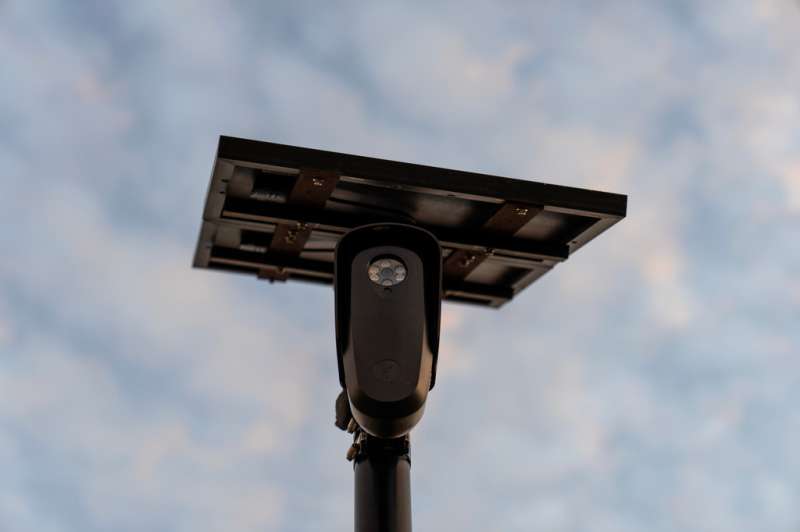
OGDEN – The arrest of an activist in Weber County has sparked concern among activists and a local legislative candidate that police are sending a message to anti-Flock Safety groups.
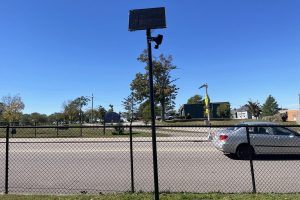
On Oct. 25, Weber County sheriff’s deputies arrested activist David Belnap in Marriott-Slaterville after he placed signs that identified the locations of automatic license plate readers (ALPRs).
Sheriff Ryan Arbon told KSL that police encountered Belnap after a resident reported a man with a ladder at one of the ALPRs. Arbon told reporters that a deputy told Belnap to take the sign down or be arrested. Belnap told Fox 13 he chose the arrest.
The signs specifically called out Flock Safety cameras, a common ALPR brand, featuring a photo of an eye with the words “Flock is watching you.”
The sign also named other ALPR brands: Motorola, Axon, and Genetec.
According to jail records, Belnap was arrested and jailed on accusations of altering, defacing, damaging, knocking down, or removing a traffic-monitoring device.
The progressive grassroots organization Indivisible Ogden, which Belnap co-leads, said the arrest is an attack on First Amendment rights.
The group said in a social media post that Belnap’s signs were not blocking or harming the Flock camera.
“WE OBJECT TO HIS BEING JAILED FOR A NON-VIOLENT, FREE-SPEECH ACTION,” the group wrote.
Belnap was released on Oct. 26 and has been formally charged with a misdemeanor. He told KSL that he plans to fight the charge.
Why is a Senate candidate worried?
CJ Hernandez, the Democratic candidate for Senate District 5, said the arrest concerned her too.
The district includes parts of Weber County and has seen an uptick in resistance to Flock cameras.
Hernandez previously told Utah Junction that she’d heard privacy concerns over Flock during her campaign.
In a recent interview with Utah Junction, Hernandez said Belnap’s arrest felt like an escalation.
“From a legal standpoint, the arrest of a citizen who is doing basically no harm, but informing the public of public surveillance seems extremely excessive,” Hernandez said.
The arrest, she said, felt like police were trying to send a message to activists.
“On the first blush, it seems like they might be trying to quiet the crowd, so to speak. Suppress these kinds of actions.”
Residents at odds with police over Flock cameras
Police and city officials have clashed with District 5 residents in the last few months over ALPRs—with varying results.
In September, Washington Terrace residents successfully convinced city council members to end a proposed trial agreement with Flock before any cameras could be placed. Three ALPRs were already installed in the city at the time, but were placed by the Weber County Sheriff’s Office, not the city.
According to the Ogden Police Department’s records, 41 Flock cameras operate within city limits. Ogden Police Chief Jake told city council members during an Oct. 13 work session that the cameras are under strict management and have been used for recovering stolen cars and identifying suspects.
However, the cameras have seen vocal opposition from residents.
Belnap’s arrest sparked even more action in Ogden. On Oct. 26, about 30 people gathered near the Weber County Sheriff’s Office in Ogden to protest the arrest and advocate for better ALPR regulation.
“Arrest of a person nonviolently exercising their First Amendment rights is a five-alarm fire for all of us,” Indivisible Utah County posted.
Hernandez agreed with the sentiment and called the arrest a warning sign.
“This is a signal. I’ve seen it in other countries I’ve served where there is a quieting effect when you start arresting activists. It can go downhill very quickly.”
A way forward?
For her part, Hernandez hopes to serve as an intermediary between residents and law enforcement as the discussions around Flock and ALPRs continue.
If elected, Hernandez said her priority is to constituents. But she thinks there is a way to find common ground.
“The citizens and those who are policing them need to be on the same side with the same goals of keeping the community safe. And that seems to be a little bit at odds, where you have this severe privacy concern [that] seems to be dwarfing what benefits we may be seeing from the security side.”
Hernandez wants to get more information on the way ALPRs are used and learn more about whether they’re actually effective at reducing crime.
Her Republican opponent, state Rep. Jill Koford (R-Weber), did not respond to requests for comment before publication. Koford has previously expressed that ALPRs need regulation to ensure they aren’t encroaching on Fourth Amendment rights.