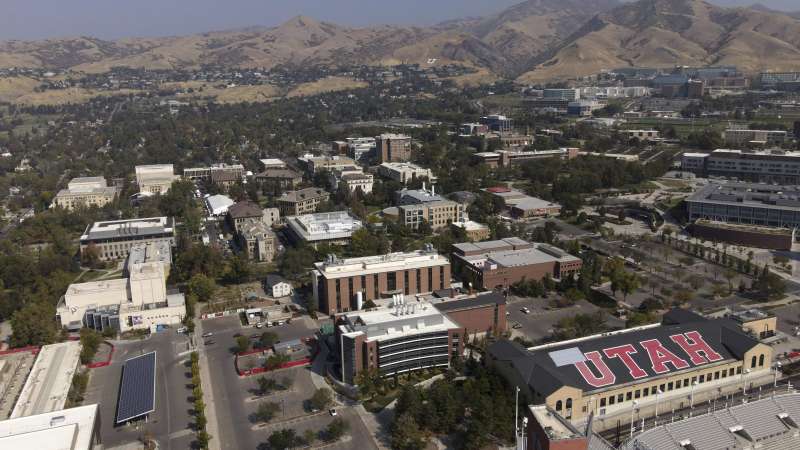
SALT LAKE CITY – University of Utah students are pushing to make the campus safer for immigrants.
The U isn’t alone — student governments at DePaul, the University of Cincinnati and other schools have made similar demands since January amid stepped-up ICE activity nationwide.
Student leaders, in collaboration with Communications Workers of America Chapter 7765 and MEChA de U of U, have asked the university to declare itself a sanctuary campus and formally commit to upholding constitutional protections for students.
Alondra Marquez, the local secretary for CWA 7765, told Utah Junction that the union has been fighting a broader campaign for university employees called the “U for Who?”
That broader campaign, which seeks workplace protections for university employees, has since folded in the push for a sanctuary campus designation.
The U had 3,000 international students as of 2025, and Marquez said the lack of clarity from the university about protections from unconstitutional immigration enforcement leads to worry.
“There are no clear policies, and that creates a lot of fear, and it directly undermines students’ success and worker safety,” she said.
Two separate arrests of U of U students – Caroline Dias Goncalves and Lisandro Pantaleon Pacheco – have made headlines in recent years, although neither student was arrested on campus.
What Joint Resolution 10 calls for
The Associated Students of the University of Utah (ASUU) then drafted Joint Resolution 10, which calls for protections for both students and employees of the school.
The resolution seeks to:
- Institute “know your rights” training for students and staff.
- Update the university’s nondiscrimination policies to include nondiscrimination based on citizenship, immigration, documentation or international status.
- Limit the gathering of “nonessential” data regarding immigration status.
- Restrict immigration authorities from accessing private information or private on-campus spaces without a direct court order or judicial warrant.
Colleges nationally lost a layer of federal protection in 2025, when DHS ended a policy that had generally kept ICE from operating at schools.
The resolution’s sponsor, London Reynolds, who chaired ASUU’s Advocacy and Affinity Legislative Committee, said she began working on the legislation in March. The ASUU’s Assembly and Senate have both passed it.
“In putting that together, my focus was pushing for an affirmation of every existing constitutional protection that students have,” Reynolds said.
Administrative review and ‘institutional neutrality’ concerns
During the University of Utah Board of Trustees Aug. 11 meeting, the ASUU Student President Erica Stringham presented a report that included the sanctuary campus resolution.
“We recognize that this is a very important issue that is deeply important to many members of our community. And as trustees, we care deeply about the success, safety, the sense of belonging of all of our students at the U. Many of the issues raised involve state and federal law and the Board of Higher Education policy that extend beyond this board’s delegated authority,” the board’s chairwoman, Katie Eccles, said in response.
The resolution is under review by the Utah System of Higher Education (USHE). Reynolds said USHE is concerned it would undermine the system’s institutional neutrality guidance — guidance USHE adopted following a 2024 state law limiting campus institutions from taking positions on political issues — which states: “‘Institutional neutrality’ means that an institution of higher education does not take positions on political, social, or cultural controversies, public debates, or flashpoint moments except when those issues impede the institution’s mission or functioning, its role as a discoverer and disseminator of knowledge, or its values of free expression and inquiry,” the USHE guidance reads.
Reynolds argues that unconstitutional immigration searches impede the U’s mission statement.
“Without the provisions that are outlined in Resolution 10, the threat of unconstitutional immigration enforcement has the potential to directly, significantly, and specifically impact the university’s stated mission,” Reynolds said.
Both Reynolds and Marquez said the resolution has drawn wide support from students.
Next steps and moves
The student groups behind the resolution are still waiting to hear from USHE about whether they can move forward, but Reynolds said she’s hopeful.
“To us, it seems very cut and dried,” she said.
As they wait, Marquez said they’re working with individual departments within the school to see what can be implemented.
Christopher Nelson, the university’s chief relations officer, told KSL in August that the school has already provided staff and faculty guidance on how to respond to ICE activity on campus.
The U.’s chief safety officer, Keith Squires, also told the Board of Trustees in March that campus police had no intention of participating in immigration enforcement.