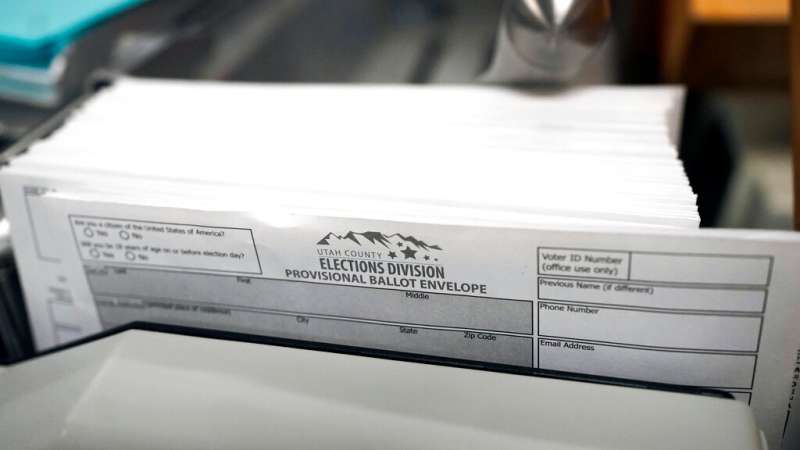
SALT LAKE CITY – As the November general election nears, Utah’s election officials are gearing up to ensure the voting process is secure.
Utah’s elections are run by Lt. Gov. Deidre Henderson (R-Utah). Henderson and the state’s county clerks are responsible for maintaining secure voting.
Active, registered voters automatically get a ballot in the mail and can choose to vote by mail or in person.
In Utah, every ballot sent in by mail has a unique barcode. That ensures voters only cast their vote once.
In-person votes are cast on voting machines. Those machines cannot be connected to the internet.
The machines undergo a series of tests when they’re initially installed and before every major election. The Office of the Lieutenant Governor also conducts random tests on machines to ensure everything is working properly.
What happens after my ballot is received in Utah?
Ballots are received into the elections office in batches.
When processing begins, election workers take the privacy tab off the ballot to remove your identifiable information. This also reveals the signature on the ballot, and workers then verify it matches what is on your voter registration form. Your ballot remains sealed through this process.
If your signature cannot be verified or you forgot to sign, the county clerk will alert you to the issue. That alert may come through a mailed letter, email, phone, or text message. You’ll be given several options on how to cure your ballot.
After election workers verify your signature, your ballot will be sent for counting. It’s at this point that your ballot is removed from the envelope and sent through scanners to tally the votes.
Throughout this process, the state has at least two trained election workers who are under oath. Additionally, a chain of custody is maintained throughout the process.
All equipment during processing, like the scanners, is subject to the same standards as in-person voting machines. They are not connected to the internet, tested frequently, and subject to audits.
What happens next?
Votes are not compiled or released until after polls close on Election Day.
A post-election audit is then conducted by election staff during a public meeting. Staff takes a random sample of ballots and manually reviews them against system-tabulated records. The results of this audit are then sent to the State Board of Canvassers and the lieutenant governor.
Election officials begin updating preliminary results online, but those results are not official until they are certified.
According to the state, counties may be counting votes until up to two weeks after Election Day.
Results are certified by the board of canvassers and are not considered official until then.